What Alamo's Wildly Different Price Reports Are Actually Telling You
September 3, 2026
September 3, 2026
Two reports on the same town, covering overlapping months in 2026, told almost opposite stories. In November 2025, Redfin had Alamo's median sale price at $2.8 million, up 12.4 percent year over year, with homes selling in 27 days. By May 2026, a separate monthly tracker showed the median sale price at $2.27 million, down 15.9 percent from April and down nearly 20 percent from the same month a year earlier, with average days on market nearly doubling from 44 to 81. Meanwhile Redfin's own May 2026 read on the town, using its all-home-types figure, put the median at $2,698,385, up 7.9 percent year over year. By July, Movoto had the median list price at $3.54 million.
None of these numbers are wrong. That is the part worth sitting with. If you have been watching Alamo from the outside trying to decide whether now is a good time to list or buy, you have almost certainly hit this same wall: four credible-looking sources, four contradictory headlines, all technically accurate. The explanation isn't fraud or bad math. It's what a median does in a town this small when the handful of homes that sell in any given month aren't very much alike.
Alamo's most extreme illustration of this problem is a 22-bedroom, 10-bathroom compound on 21 acres called Fieldhaven Estate, a French-country-style property with a geese fountain dating to the 1800s, an aviary, and a car barn built for 20 vehicles. The owner bought it for $19 million, spent $7 million on upgrades, and listed it for $23 million. After two years without a buyer, the price came down by $12 million, a cut reported by the San Francisco Chronicle in December 2025 as part of its look at the East Bay's most exclusive enclaves.
That single closing, whenever it eventually lands, will drag whatever month it falls in toward a much higher median. If it slips a month, or falls through entirely, the town's headline number shifts by hundreds of thousands of dollars with zero change in what an ordinary buyer paid for an ordinary house. This matters because Alamo simply doesn't have many sales to work with. Redfin counted 14 closings in November 2025. Movoto counted 32 in February 2026. The May 2026 report counted 24. Contra Costa County as a whole logs roughly 11,700 sales a year, a pool large enough that one outlier compound gets absorbed without moving the county average. Alamo's monthly sample is too thin for that kind of statistical cushioning. One estate-sized outlier, or its absence, is the whole story some months.
If you want a number worth trusting, it's the one that compares the same measurement to itself over a full year. The Chronicle's Compass-sourced data showed Alamo's median detached home price at $2.7 million in 2024, averaging 26 days on market, easing to nearly $2.5 million in 2025, averaging 28 days. That's a real but modest pullback, roughly 7 percent over twelve months, with almost no change in how fast homes moved. For comparison, nearby Diablo's 2025 median sat higher at $3.3 million but took longer to sell, averaging 35 days.
That annual, same-source, same-property-type comparison is the read worth acting on. The month-to-month swings you'll find on tracking sites almost always mix things that shouldn't be mixed: list price against sold price, single-family homes against the all-home-types figure, one provider's closed sales against another's active inventory. Once you know that, the "market crashed" and "market surged" headlines stop feeling like a mystery and start looking like an artifact of measurement.
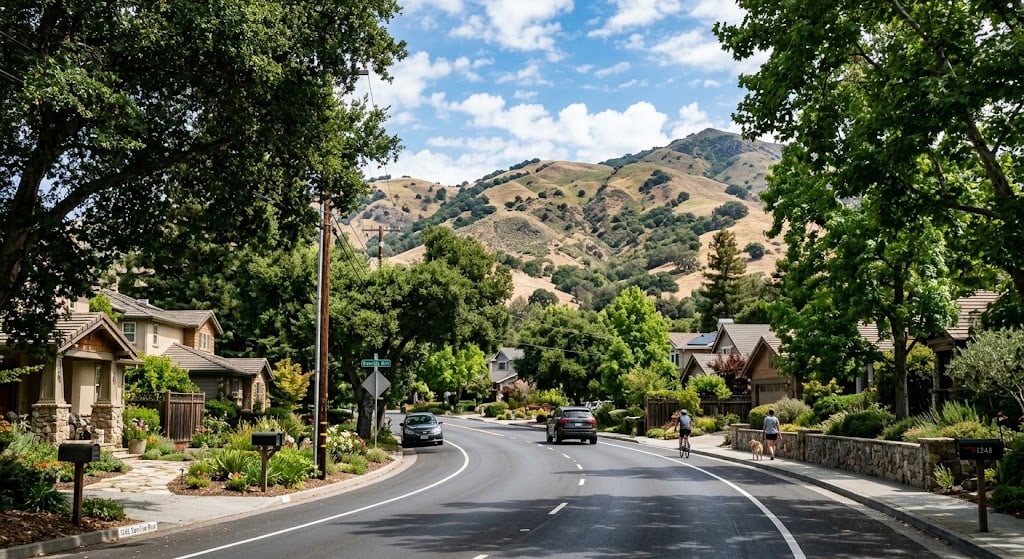
Alamo has no city government and no downtown to anchor comparisons the way Danville's Hartz Avenue corridor does. Everything from dining to retail to entertainment requires a drive to Danville or Walnut Creek, and the town's only real commercial cluster sits along Stone Valley Road. That absence of a center is part of the appeal for buyers who choose Alamo specifically for privacy and acreage, but it also means the housing stock is scattered across genuinely different pockets rather than radiating out from one recognizable core. A few that come up repeatedly in listings and local coverage:
A Round Hill fairway estate and a flag-lot ranch off Stone Valley Road are both technically "Alamo." They are not comparable inventory, and pricing either one against the town-wide median printed on a portal homepage is how a listing sits overpriced by six figures, or how a rare property gets undervalued because nobody adjusted for what actually makes it different.
If you're weighing Alamo against Danville or Blackhawk, the comparison isn't apples to apples on structure alone. Danville is an incorporated town with a walkable downtown, a farmers market, and community life that took decades to build. Blackhawk is unincorporated like Alamo, but it's a master-planned community of 2,027 home sites across six gated neighborhoods connected by a three-mile private jogging trail, entered through four gates, three staffed around the clock. That structural uniformity, the same club, the same gates, the same product tier across most of the community, tends to produce a tighter, less noisy median than Alamo's, even in a similarly sized data set. Alamo's inventory ranges from modest flag lots to twenty-plus-acre compounds with no HOA imposing consistency between them, so its median will keep looking more erratic than Blackhawk's for structural reasons that have nothing to do with demand.
One more wrinkle worth knowing if you're evaluating larger Alamo parcels as an investment: some 2026 buyers are adding detached accessory dwelling units on the town's characteristic half-acre-plus lots, generating supplemental monthly rental income in the mid three to four thousand dollar range. That means two "comparable" large-lot sales in the same pocket can carry very different values depending on whether an ADU is already built in, another reason a single townwide median flattens details that actually matter to price.
Is Alamo's market actually cooling in 2026? The most reliable same-source comparison available shows detached home prices easing modestly, roughly 7 percent, from 2024 to 2025, with days on market barely changing. That's a market softening at the margins, not one falling apart.
Why do two sites report opposite year-over-year numbers for the same month? They're rarely measuring the same thing. One may track sold prices for single-family homes only, another may blend condos and townhomes into the figure, and a third may be comparing list price to last year's sold price. In a market with only a couple dozen closings a month, those methodology differences produce headline numbers that look contradictory even when both are accurate.
Does the townwide median tell me what my home is worth? No more than a countywide average would. Treat it as a rough compass heading, not a valuation. What your specific home is worth depends on its pocket, its lot, its condition, and what actually closed near it recently, not what closed somewhere across town.
If you're trying to figure out what a specific Alamo property is actually worth in this kind of market, that's not a headline-number question. It's a comp-by-comp one. Ria Rossi Real Estate works these pockets closely enough to know the difference between a Round Hill fairway estate and a Stone Valley flag lot, and how to price or evaluate either one on its own terms. Schedule a white-glove home strategy consultation to talk through what your corner of Alamo is really doing right now.
Stay up to date on the latest real estate trends.
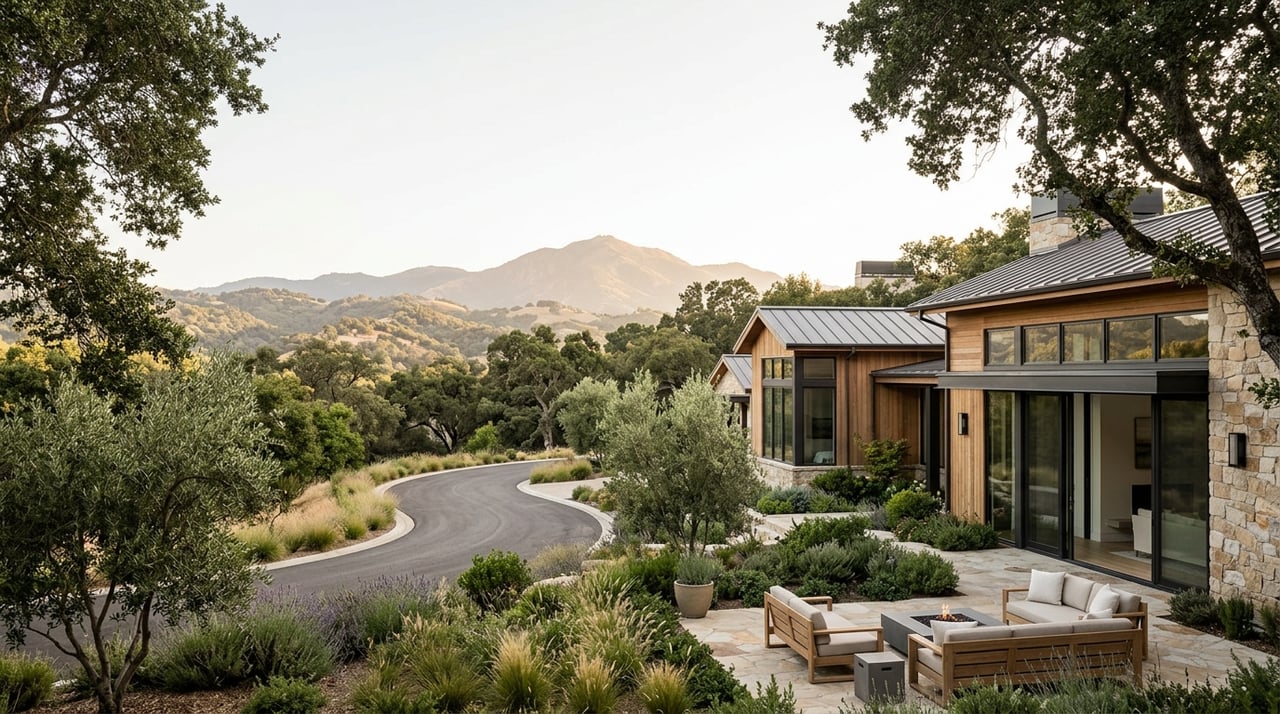
Find the Alamo Neighborhood That Fits the Way You Want to Live
Connect with Ria Rossi for trusted, tailored guidance in the East Bay luxury market. Your next chapter begins here.